New earning opportunity: AIAICO ($AIA) introduces staking vaults
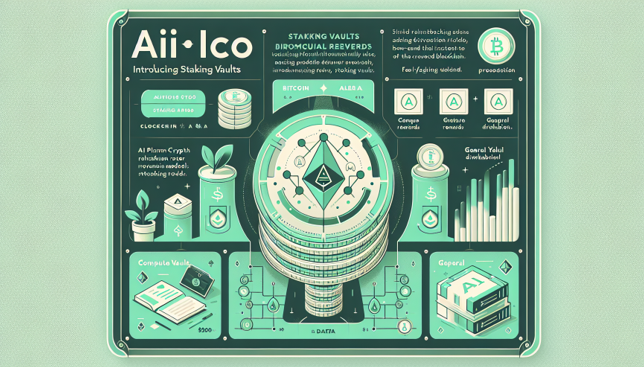
Another day, another staking program on BNB Chain. But AIAICO might actually be worth paying attention to. The project just launched staking vaults for $AIA holders, and the mechanics behind the yields tell a more interesting story than the usual "stake and pray" setup.
What AIAICO is building
AIAICO ($AIA) is a BNB Chain token that sits at the intersection of artificial intelligence and decentralized finance. The platform provides AI-powered tools for crypto traders and portfolio managers -- think automated analysis, sentiment tracking, and trade signal generation. $AIA functions as the utility token for accessing premium features. Free tier gets you basic analytics. Holding and staking $AIA unlocks progressively better tools, faster data feeds, and exclusive AI models trained on proprietary datasets.
The vault structure
AIAICO didn't just slap a generic staking contract together. The vaults are structured around the platform's AI infrastructure:
Compute vaults. Stake $AIA to fund distributed AI computation. Returns scale with platform demand for processing power. When more users are running AI models, compute vault depositors earn more.
Data vaults. Stake to support the protocol's data collection and training pipeline. These carry slightly lower yields but offer more stability since data demand is less volatile than compute spikes.
General yield vaults. Traditional staking for people who don't care about the infrastructure angle. Deposit $AIA, earn $AIA. Simple. Each vault has different lock durations and reward curves. Compute vaults are the riskiest but offer the highest potential returns. Data vaults sit in the middle. General yield vaults are your safe(ish) option.
Why AI + DeFi staking is interesting
Most DeFi staking rewards come from either inflation or trading fees. AIAICO adds a third revenue stream: actual product revenue. People pay $AIA to use AI tools. That usage revenue funds staking rewards. It's a genuine business model backing the yields, which is rarer than it should be in DeFi. The AI services market in crypto is growing fast. Automated trading tools, risk assessment models, portfolio optimization -- demand for this stuff keeps climbing as markets get more complex. If AIAICO captures even a small slice of that market, the staking economics hold up.
Checking the fundamentals
Before throwing money into any vault, run through the checklist:
Token supply. The team has secured their token allocation through a token locker. No surprise sell-offs incoming from team wallets. That's the baseline.
Liquidity. The $AIA liquidity pool is locked via liquidity locker, meaning the trading pool on PancakeSwap can't be drained. For anyone staking in the general yield vault, knowing the token's trading liquidity is protected matters a lot.
Contract design. Vault contracts include emergency withdrawal functions with a penalty fee. Not ideal -- you lose a percentage if you panic-exit -- but having the option beats being completely locked with no escape hatch.
Real numbers vs promises
The team has been transparent about one thing: they won't publish fixed APY guarantees. Yields depend on platform usage, and platform usage depends on market conditions, user growth, and product quality. What they have shared is the fee distribution breakdown:
- 40% of platform revenue to staking vaults
- 30% to development and operations
- 20% to treasury reserves
- 10% to community initiatives
That 40% allocation to stakers is aggressive. It signals the team prioritizes holder retention over short-term treasury accumulation.
Who should consider staking $AIA
Staking makes sense if you:
- Already hold $AIA and plan to keep it for 30+ days
- Believe AI tools for crypto trading will see growing demand
- Want exposure to a yield source that isn't purely inflationary
- Can tolerate smart contract risk (as with any DeFi protocol)
It probably doesn't make sense if you're looking for guaranteed returns or need daily liquidity on your full position.
How to get started
- Pick up $AIA on PancakeSwap
- Head to the AIAICO staking dashboard
- Choose your vault type
- Approve and deposit
BNB Chain gas fees keep the whole process dirt cheap. Even if you're staking a relatively small position, transaction costs won't eat your lunch. The staking vaults are live now. Whether the yields hold up depends on AIAICO's ability to grow its user base and deliver AI tools people actually want to pay for. That's the real bet here -- not the staking APY, but the product behind it.
